In This Article
At two in the morning, your house makes a confession it would never make at noon. With the dishwasher off, the street quiet and no one drawing water, a faint hiss or a soft trickle can stand out clearly, and that sound is often a hidden leak announcing itself. Night is the best leak detection tool you already own.
This guide teaches the quiet house method step by step: how to silence the home properly, how to use the water meter as your referee, how to listen at the right points with a simple trick or two, and how to tell a real leak sound from the normal noises a house makes after dark.
Step One: Set the Stage for Silence
Listening only works when the competition is quiet. Pick a calm night and give the house fifteen minutes to settle before you start:
- Stop all water use. No faucets, no flushing, and pause the dishwasher and washing machine cycles.
- Silence the noisemakers. Turn off the HVAC fan, the aquarium pump if it hums, and any appliance that cycles at night.
- Mind the ice maker. A refrigerator ice maker fills periodically and sounds exactly like a small leak. Note when it runs, or lift the bail arm to pause it during your test.
- Wait for the pipes to rest. After the last water use, give the system a few minutes so normal flow sounds fade away.
What remains after this routine is the honest sound of your house, and anything watery in it deserves attention.
Pick your night with a little care. A windy night adds roof and tree noise, and a night right after a storm adds gutter drips and downspout trickles that can imitate a leak for an hour. A calm, dry night gives the cleanest result. If your first attempt is noisy, repeat it on a better night before drawing conclusions either way.
Step Two: Let the Meter Be the Referee
Before you trust your ears, get a verdict from the water meter. Find the meter, usually near the street, and look for the small leak indicator, often a triangle or star shaped dial. If it is turning while every fixture in the house is off, water is moving through your plumbing with nowhere honest to go.

No visible indicator? Write down the meter reading, wait one to two hours without using water, and read it again. Any change means water left the system. The meter does not care how quiet the leak is. It counts everything, which makes it the perfect referee for the listening test that follows.
Write the reading down with the time and date, and photograph the dial if your phone is handy. Memory rounds numbers and forgets which reading came first. A photo does neither. If the overnight reading moved only slightly, repeat the test the next night: a true leak repeats its performance, while a one time appliance cycle usually does not.
Step Three: Listen at the Right Points
Leak sound travels through pipe walls and building materials, so where you listen matters more than how hard you listen. Work through these points slowly:
- At the main shutoff and water heater: supply sounds often carry here, and these spots are easy to reach.
- At each toilet: put your ear near the tank. A faint hiss can mean a fill valve leaking silently into the bowl.
- Along bathroom and kitchen walls: pipes cluster here, and wall cavities carry sound well.
- On hard floors above suspect areas: a warm or damp feeling spot is worth a careful listen.
- At hose bibs and the irrigation shutoff: outdoor lines leak quietly and are easy to forget.
Move slowly and pause at each point. A leak sound usually grows clearer as you approach the source and fades as you move away, and that gradient is your map.
The stethoscope trick: ears alone miss a lot. A few low effort aids sharpen them. An inexpensive mechanic's stethoscope, or even a medical one, pressed against a pipe or wall makes faint hissing far easier to hear. No stethoscope? An empty drinking glass or a long screwdriver with the handle at your ear works on the same principle: solid contact carries vibration better than air.
Your phone can help too. A voice recorder app held against a wall or floor captures sounds you can replay and compare between rooms. Record at several points and note which recording sounds strongest. Keep expectations honest: these tricks confirm and roughly locate a sound. They do not replace instruments when the leak is deep or the pipe is plastic.
Work in a fixed order so you can compare honestly: start at the meter side of the house, move through bathrooms, then the kitchen and laundry, and finish at the water heater. At each stop, be still for a full half minute. Human hearing adjusts to quiet slowly, and sounds that are invisible in the first ten seconds often separate themselves once your ears settle.
Leak Sounds Versus Normal Night Noises
Houses talk at night, and most of it is innocent. Pipes tick and creak as hot water lines cool and contract. A water heater rumbles softly as sediment shifts and the burner cycles. The refrigerator hums and clicks. These sounds come and go, and they follow appliance activity.
A leak sounds different in three ways. It is continuous rather than occasional. It stays in one place rather than wandering room to room. And it keeps company with the meter: if the sound never stops and the leak indicator never rests, the two witnesses agree. In Lynnwood homes we often find the sound is loudest in the quietest room, far from where the homeowner first noticed a stain, because sound travels along the pipe run.
How Professionals Take Listening Further
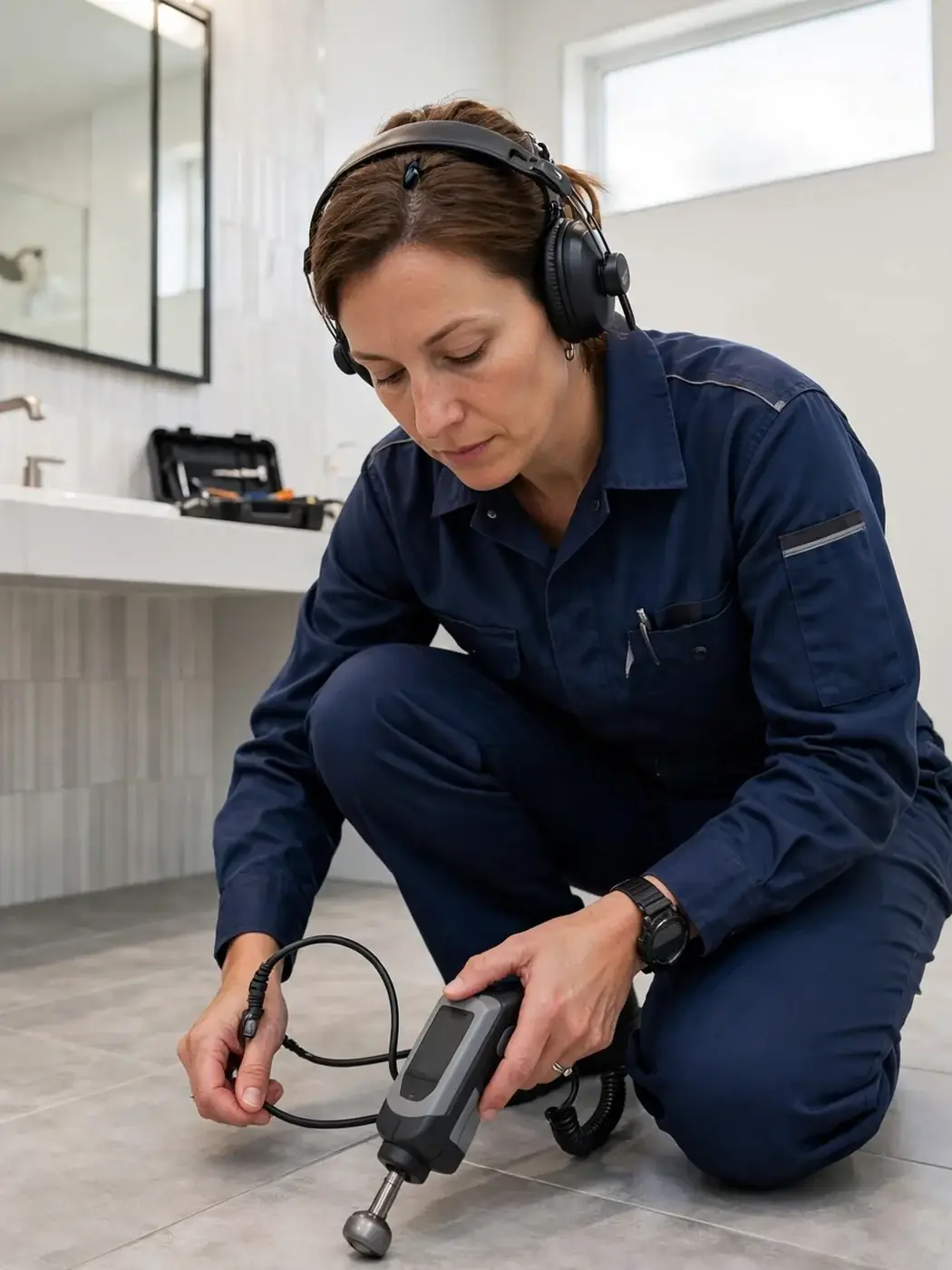
Professional acoustic leak detection is the quiet house method with far better ears. Ground microphones amplify the leak signature and filter out traffic, wind and appliance noise. Listening probes read sound directly from pipes and valves. On buried lines, correlators place sensors at two points and calculate the leak position from the tiny time delay between them.
At ProLine Leak Fix Pros, a technician will usually start exactly where you did, with a meter confirmation, then survey listening points across the home in Snohomish County, comparing signal strength until the strongest point is marked. Thermal imaging or tracer gas then verifies the spot before any repair begins. If your night listening found something real, that professional pass turns a suspicion into a location.
One more sound deserves a mention: the faint, irregular patter of a drain leak. Supply leaks hiss steadily because they are under pressure. Drain leaks only speak when water is sent down the drain, so they stay silent during a night test and appear when a shower or washer runs. If your sound only follows fixture use, think drain, and test by running one fixture at a time while a helper listens below.
Conclusion: Trust the Quiet
You do not need special gear to learn whether your house is leaking. You need one quiet night, a meter reading, and a slow walk with your ears open. Continuous sound plus a moving meter is a combination worth acting on.
Try the method this week, even if you suspect nothing. Knowing what your house sounds like when it is healthy makes the unhealthy nights impossible to miss.
Share what you heard when you call. Notes like a hiss near the hall bathroom, strongest at 2 am, silent near the kitchen, are genuinely useful to a technician planning where to place sensors first. Your night of listening is not replaced by the professional visit. It becomes the first page of its report.