
In This Article
The ceiling drips during storms and stays dry for weeks of sunshine. The basement wall weeps after heavy rain and behaves all summer. A leak that keeps rain's schedule is telling you something important: the water is probably not coming from your plumbing at all. It is coming from outside, through the roof, the siding, the foundation or the ground itself.
Chasing a rain leak with plumbing logic wastes time, and chasing a plumbing leak with roofing logic does the same. This guide shows how to use storm timing as evidence, how to log the pattern properly, and how professionals separate outside water from pipe water when the answer is not obvious.
What a Rain Schedule Tells You
Timing is the first and strongest clue. Note three things about any rain linked leak: how long after rain starts the water appears, how heavy the rain must be, and how long the wetness lasts after the storm ends. Each detail points somewhere:
- Appears quickly in light rain: often a direct opening high up, such as damaged flashing, a cracked vent boot or a failed window seal.
- Appears only in heavy or wind driven rain: often siding joints, flashing laps or gutters that overflow only when overwhelmed.
- Appears hours after rain and lingers for days: often groundwater: soil saturation, foundation cracks or a high water table pushing in from below.
- Appears with snow melt or long wet spells: slow accumulation paths, such as grading that holds water against the house.
In Lynnwood, where fall and winter bring long, soaking rains, these patterns repeat often enough to read clearly if you write them down.
Wind direction deserves its own line in the log. Many entry points only fail when rain is driven against one specific wall, so a storm from the south may produce a leak that a storm from the north never does. After a few events, homeowners often discover their leak has a compass heading, and that heading points the repair crew at the right side of the house immediately.
Log the Pattern Like a Detective
Memory blurs storms together. A simple log does not. For each wet event, record:
- Date and storm notes: when rain started, how hard it fell, and whether wind drove it against one side of the house.
- Delay: how long after the rain began the leak appeared.
- Location and size: photograph the spot with something for scale, and note if it grows during the storm.
- Plumbing alibi: note what fixtures were used that day. If the leak appears on a no use, no rain day, your suspect list changes completely.
- Drying time: when the spot finally dries after the storm ends.
Three or four logged events usually reveal the pattern, and that log is gold for any professional you bring in, roofer, waterproofing contractor or leak detection specialist.
Photographs deserve one caution: take them during the event, not after. A stain photographed dry the next morning looks identical whether it was soaked for an hour or merely damp. During the storm, note whether the spot is actively dripping, merely damp, or growing, and get one photo of the whole wall for context plus one close photo for detail.
The Common Entry Points, Top to Bottom
Outside water enters at transitions, where materials meet and seals age:
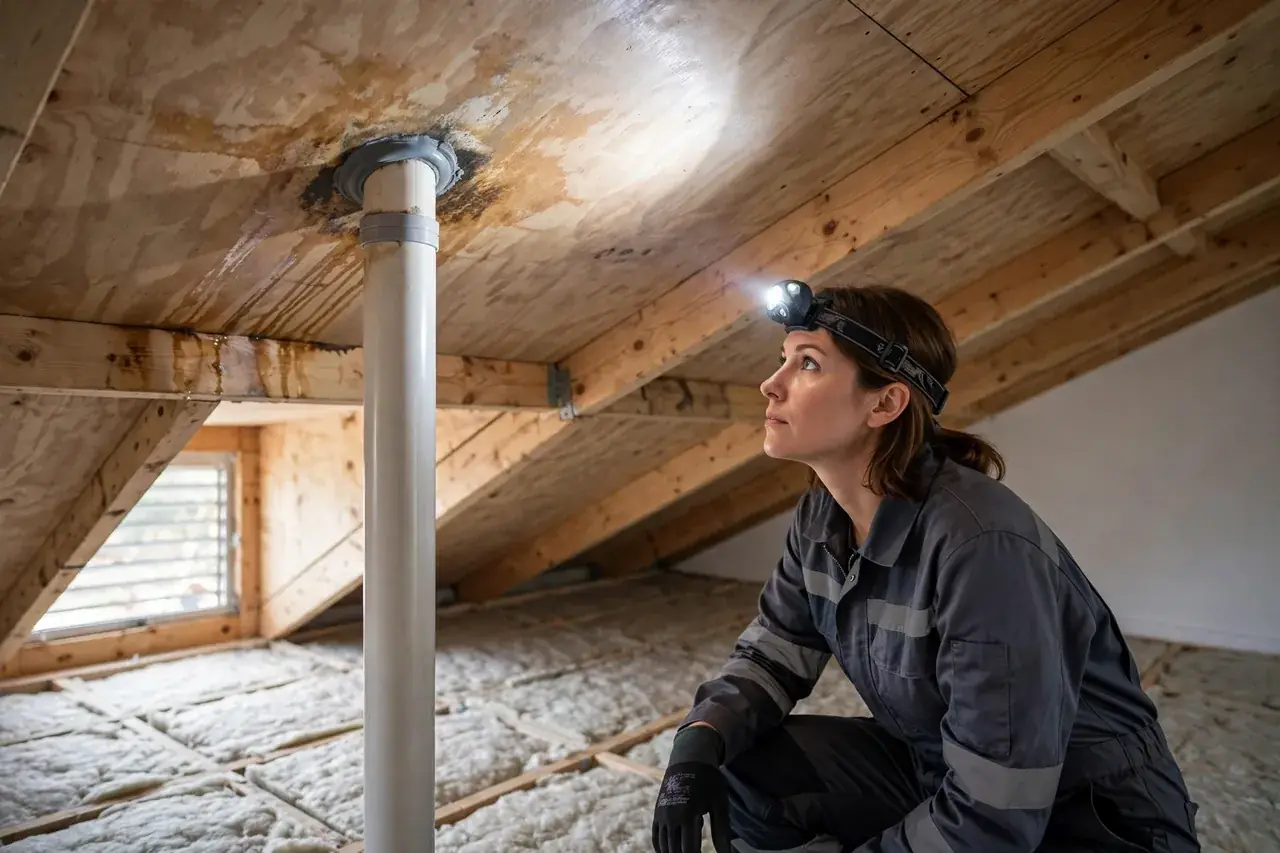
- Roof transitions: flashing around chimneys, vents and valleys, plus worn shingles near edges.
- Windows and doors: failed caulk, damaged flashing and sills that slope the wrong way.
- Siding and gutters: joints that catch wind driven rain, and gutters that pour water down one wall when they clog or overflow.
- Foundation line: cracks, pipe penetrations and soil graded toward the house, which deliver groundwater to the wall.
- Below grade: window wells that fill, and drainage that has clogged or collapsed over the years.
Notice what is missing from the list: pipes. A rain timed leak almost always enters through the building shell or the ground, and the repair belongs to that system.
Gutters are the most underestimated entry point on the list. A clogged or undersized gutter does not drip politely. In a heavy storm it becomes a waterfall aimed at the siding, the window below it and the foundation line, delivering more water to one spot than the wall was ever designed to shed. If your rain leak lives under a gutter run, start the inspection there.
Rule Out the Plumbing Anyway
Almost always is not always, and two traps deserve a check. First, some plumbing leaks look rain linked by coincidence: a family home during a storm uses more water indoors, baths and laundry included, so a shower drain leak may appear on rainy weekends simply because the shower runs longer. Second, groundwater can raise crawl space moisture that condenses on cold pipes, making a sound pipe look like the culprit.
The meter test separates the suspects cleanly. During a dry spell, run the standard check: all water off, then watch the meter. A moving meter means a plumbing leak exists regardless of weather. A still meter during dry days, with wetness that only follows storms, points outside with confidence.
Below grade entries have a timing signature of their own. Water that arrives through a foundation crack after the soil saturates may keep seeping for a day or two after the rain stops, because the ground drains slowly. A spot that weeps on the first dry day after a storm is not evidence against a rain cause. It is often the strongest evidence for a groundwater one.

How Professionals Trace Rain Water to Its Entry
Professional tracing of rain leaks is a controlled experiment. Technicians use moisture meters to map how far the wetness spreads and thermal imaging to follow its path through walls and ceilings, because water cools and warms surfaces in patterns that reveal direction. The map often leads upward or outward from the stain, toward the entry point.
Where plumbing must be cleared, pressure testing and acoustic leak detection prove the pipes are sound, which is a valuable answer in itself. Controlled water testing, applying water to one suspect area at a time while watching inside, can then confirm the exact entry. At ProLine Leak Fix Pros in Lynnwood, we handle the moisture mapping and the plumbing proof, and we will tell you plainly when the fix belongs to a roofer or waterproofing trade instead.
Bring your log to that visit. Storm dates, delays, wind direction and photographs let a technician match your events against the moisture map in the walls, and the two together usually agree on one entry point. Without the log, the same visit starts from a stain and a guess. With it, the visit starts from evidence.
Conclusion: The Calendar Is the Clue
A leak that follows the weather is giving you its diagnosis for free. Log the timing, photograph the spots, and run one dry day meter test to clear the plumbing. Those three steps convert a frustrating mystery into a short suspect list.
Then fix the entry, not just the stain. Repainting a rain leak's calling card without sealing its door guarantees it will visit again next storm season.
Rain will test your house again, that much is certain in this part of Washington. The goal is not to fear the forecast. It is to meet the next storm with the entry points sealed, the gutters clear and the pattern understood, so the weather stays outside where it belongs.