In This Article
A warm spot on the floor, a water bill that keeps climbing, the sound of running water when nothing is on: a slab leak is confirmed under your concrete foundation. Now comes the decision that actually matters. Choosing among the available slab leak repair options will affect your home, your budget, and your peace of mind for years, so it pays to understand all three paths before you agree to anything.
In this guide, we explain the three main approaches in plain language: spot repair, reroute, and full repipe. You will learn what each one involves, where each shines, where each falls short, and which factors should drive your choice. No pressure, no jargon, just the facts a Lynnwood homeowner needs.
You Found the Leak. Now What?
A slab leak means a water line buried in or under your concrete foundation has failed. The pipe is still pressurized, so water keeps escaping into the soil or up through the slab around the clock. The first job, before any repair decision, is confirming exactly where the leak sits. That is what professional slab leak detection does: using acoustic sensors, thermal imaging, and pressure testing, a specialist pinpoints the failure within a small area so the repair can be surgical instead of a guessing game.
Once the leak is located, the real question begins. Repairing a slab leak is not one-size-fits-all, because the right fix depends on the age and condition of your pipes, where the leak is, and whether this is the first failure or the fourth. The three slab leak repair options below cover the full range, from the smallest possible fix to a complete fresh start.
Option 1: Spot Repair
Spot repair is the most direct of the slab leak repair options: open the concrete at the pinpointed leak location, cut out the damaged section of pipe, and install a new section with proper couplings. Then the slab is patched and the flooring is restored. It fixes the exact problem and nothing more.
How it works
Because the leak has been precisely located, the contractor only needs to break through a small section of slab, usually just a few square feet, directly above the failure. The damaged pipe section is removed, a new section is joined in, the line is pressure tested to confirm the repair holds, and the concrete is patched back to grade. Flooring over the patched area is replaced to match as closely as possible.
Pros
- Least disruptive: Only a small area of slab and flooring is disturbed. Most of the home stays untouched.
- Fastest option: A straightforward spot repair is often completed in a day or two, with water service restored quickly.
- Targeted cost: You are paying to fix one problem, not to replace an entire system, so the scope stays small.
Cons
- Leaves old pipe in place: The rest of the aging line under the slab stays exactly as it was. If the pipe is corroding, the next leak may already be forming nearby.
- Concrete work inside the home: Jackhammering a slab means noise, dust, and a patch in your floor that needs restoring, even when the opening is small.
- Risk of repeat repairs: Homes with one slab leak often develop more. A second or third spot repair in the same system can end up costing more in total than a reroute would have.
Spot repair makes the most sense when the pipe system is otherwise in good shape: newer plumbing, a single isolated failure, and no history of leaks. If your home has copper lines that are decades old and this is already the second or third leak, read on before choosing this option.
Option 2: Reroute
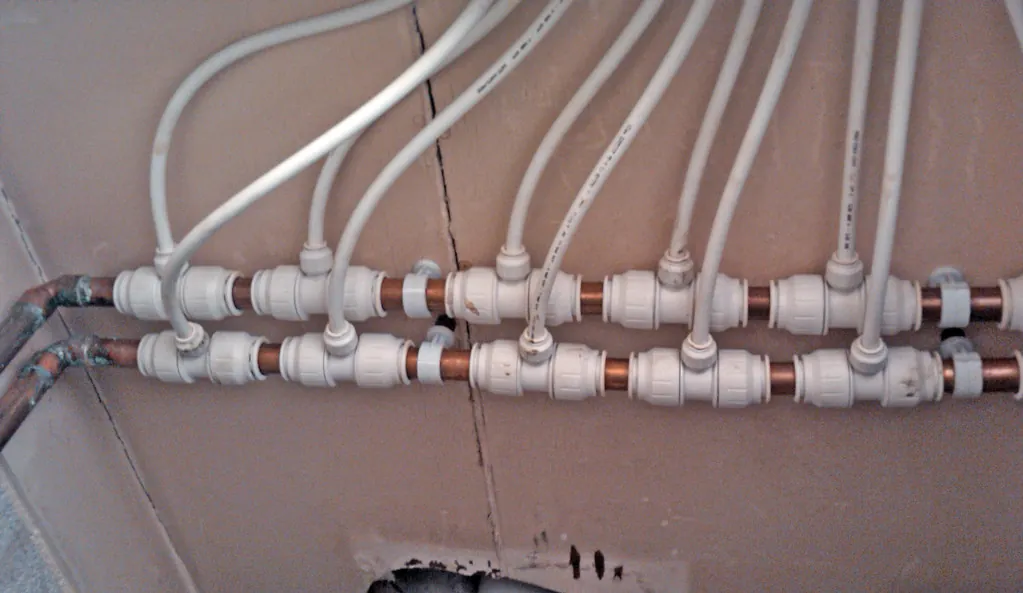
A reroute takes a completely different approach. Instead of opening the slab, the leaking line is capped off and abandoned in place, and a brand-new line is run to serve the same fixtures through an accessible path: overhead through the attic, through wall cavities, or along the exterior of the home. The new pipe never touches the slab at all.
How it works
The technician first maps which fixtures the failed line serves, then plans a new route from the water source to those fixtures through accessible space. New pipe is installed along that route, connected at both ends, pressure tested, and put into service. The old leaking line is left sealed under the slab, permanently out of the system. Because the new line runs where it can be seen and reached, any future problem with it is far easier to find and fix.
Pros
- No slab demolition: Nobody breaks through your foundation. Floors, tile, and finished surfaces stay intact.
- Brand-new line: The replacement section is new pipe with a full service life ahead of it, not a patch on an aging system.
- Future-friendly: A rerouted line in an attic or wall can be inspected, maintained, and repaired without ever touching concrete again.
Cons
- More invasive elsewhere: Running new pipe through walls and ceilings means opening drywall in multiple rooms, then patching and repainting.
- Longer project: Planning the route, running the line, and restoring every wall and ceiling takes more time than a single spot repair.
- Freezing and aesthetics: Lines run through attics or along exteriors need proper insulation and protection from freezing, which is a real concern in Pacific Northwest winters. Routing also has to be planned so the finished result looks clean.
Rerouting is often the sweet spot for homes with aging under-slab plumbing: it abandons the problem line for good without the cost and disruption of replacing the entire system. It is also the go-to choice when the leak sits under an expensive finished floor, like a newly remodeled kitchen, where opening the slab would destroy work you just paid for.
Option 3: Full Repipe
A full repipe replaces the aging water supply system, or a major portion of it, with new pipe throughout the home. Instead of fixing one leak or abandoning one line, you retire the old plumbing entirely and start fresh.
How it works
A plumber maps the entire hot and cold water system, then installs new supply lines to every fixture, usually through walls, ceilings, and attics, similar to a large-scale reroute. Old under-slab lines are abandoned in place. The project is planned in phases so the home keeps water service as much as possible during the work, and every new line is pressure tested before walls are closed up.
Pros
- Ends the leak cycle: When the whole system is new, the pattern of one leak after another stops. This is the only option that removes the aging pipe as a future problem.
- Improves the whole system: New lines can mean better water pressure, cleaner water, and the chance to correct old routing problems all at once.
- Strong long-term value: For a home you plan to keep, a repipe protects the foundation from years of future under-slab leaks and the damage they cause.
Cons
- Biggest project: A repipe touches nearly every room. Expect drywall openings throughout the house, several days of work, and a full restoration phase.
- Highest upfront scope: Replacing an entire system is a larger investment than fixing one line, even though it can be the cheaper path over a decade of repeat leaks.
- Planning matters: The job needs a contractor experienced with whole-home repipes, careful phasing, and clean restoration, because the quality of the finish work is half the project.
The cheapest fix today is not always the cheapest fix over five years. One more leak in the same old line can wipe out everything a spot repair saved.
How to Choose Among Slab Leak Repair Options
With the three slab leak repair options on the table, here are the factors that should drive your decision. A good contractor will walk through these with you before recommending anything.
- Pipe age and material: This is the biggest factor. Copper lines in a home that is several decades old are living on borrowed time once the first pinhole appears, because pinhole leaks in copper pipes tend to multiply. Newer pipe with a single failure points toward spot repair; aging pipe with a history points toward reroute or repipe.
- Leak history: First leak ever? Spot repair is reasonable. Second or third leak in the same system? Each new repair chips away at the case for patching, and a reroute or repipe starts to make more sense.
- Leak location: A leak under a simple concrete garage floor is cheap to open; a leak under a remodeled bathroom with heated tile is a different story. The more expensive the surface above the leak, the more attractive a reroute becomes.
- Foundation and access: Post-tension slabs, thickened footings, and tight crawl spaces all affect what is practical. A site visit tells you more than any article can.
- Budget factors: We avoid quoting prices here because every home is different, but think in terms of total cost over time, not just the first invoice. Consider the repair itself, floor and drywall restoration, how long you will be without full water service, and the realistic chance of paying for another repair in the same system within a few years.
- Your plans for the home: If you are selling soon, a documented professional repair may be all you need. If this is your long-term home, investing in a reroute or repipe buys decades of peace of mind.
Questions to Ask Any Contractor
Whether you are leaning toward spot repair, reroute, or repipe, these questions will separate careful professionals from guesswork. Ask every contractor you talk to:
- How was the leak located, and how precise is the location? A repair plan built on "somewhere under the living room" is not a plan. Ask what detection method was used and how confident they are in the spot.
- What exactly will be opened, and how will it be restored? Get specifics: how much concrete or drywall comes out, who patches it, who replaces flooring and paint, and what the finished result will look like.
- What is the warranty scope? Does the warranty cover just the repaired section or the rerouted line? For how long? Get it in writing.
- What happens if you find more damage once you open things up? Ask how surprises are handled and approved before work continues, so there are no shock charges.
- Why are you recommending this option over the others? A trustworthy contractor can explain why a spot repair is enough, or why your pipe condition calls for a reroute, in terms of your specific situation.
Side-by-Side Comparison
| Factor | Spot Repair | Reroute | Full Repipe |
|---|---|---|---|
| Disruption | Small slab opening; noise and dust in one area | Drywall openings in several rooms | Openings throughout the home; longest project |
| Slab opened? | Yes, a small section | No | No |
| Old pipe remains? | Yes, most of it stays in service | The failed line is abandoned | Old system fully retired |
| Longevity | Fixes one leak; system age unchanged | New line with full service life | Entire system renewed |
| Best for | Newer pipe, first and only leak | Aging pipe, leak under finished floors | Old system with repeated leaks, long-term home |
Choosing among slab leak repair options comes down to matching the fix to the condition of your pipes, not just to the leak in front of you. A spot repair is smart when the system is young and the failure is isolated. A reroute is the practical middle ground when the old line cannot be trusted but the rest of the system still has life. A full repipe is the long-term answer when leaks have become a pattern. If you need help with the first and most important step, precise detection, or you want guidance on pipe leak repair in Lynnwood, call ProLine Leak Fix Pros at (425) 380-0028. We will find the leak, explain your options honestly, and help you pick the repair that actually fits your home. Call for availability.