In this article
Your wall looks fine. The paint is intact, there is no staining, and everything feels dry to the touch. But inside that wall cavity, moisture is silently feeding mold and rotting wood, and you will not know until the damage surfaces months later. This is the gap that moisture meters close. These compact instruments measure the water content inside building materials, revealing hidden dampness long before your eyes or hands can detect it.
Moisture meters are among the most-used tools in professional leak detection, and understanding how they work helps you understand what a proper inspection actually involves. This guide explains the two main types, the six ways professionals deploy them, and how to interpret what the numbers mean.
What Is a Moisture Meter?
A moisture meter is a handheld device that measures the moisture content of materials like wood, drywall, concrete, and plaster. Professional meters do not just say "wet" or "dry." They give quantitative readings, typically as a percentage of moisture content for wood, or as a relative scale for other materials, that can be compared across locations and tracked over time.
The key insight is comparison. A single reading means little on its own. A professional takes readings across a grid: the suspect area, the surrounding area, and a known-dry reference area of the same material. The pattern of readings draws a moisture map that points toward the source. The wettest point is usually closest to where water is entering, and readings that fall off steadily with distance confirm a single source rather than a general humidity problem.
This mapping approach is what separates professional inspection from poking at a wall and guessing. It turns "somewhere in this wall is wet" into "the moisture peaks 18 inches left of the window, at the height of the supply line."
Pin-Type vs. Pinless: How They Work
| Feature | Pin-type meters | Pinless meters |
|---|---|---|
| How it works | Two metal pins penetrate the surface; measures electrical resistance between them | Emits electromagnetic waves; measures how the material affects the signal |
| Surface damage | Leaves two tiny pinholes | Completely non-invasive, no marks |
| Depth | Reads at the depth of the pins (surface to ~1 inch) | Reads up to 3/4 to 1.5 inches deep depending on model |
| Best for | Precise readings at a specific depth; verifying exact moisture content | Fast scanning of large areas; finished surfaces you cannot mark |
| Limitation | Slow for large areas; cannot read through tile or metal | Affected by metal behind the surface; less precise at depth |
Professionals carry both and use them in sequence: the pinless meter for rapid scanning to find the damp zones, then the pin meter to verify exact readings at the critical points. Some advanced meters combine both modes in one device. Either way, the goal is the same: a reliable moisture map without unnecessary damage to your finishes.
6 Ways Professionals Use Moisture Meters
- Tracing a leak to its source. By gridding readings across walls, floors, and ceilings, the technician follows increasing moisture back to the entry point, which is often far from the visible stain.
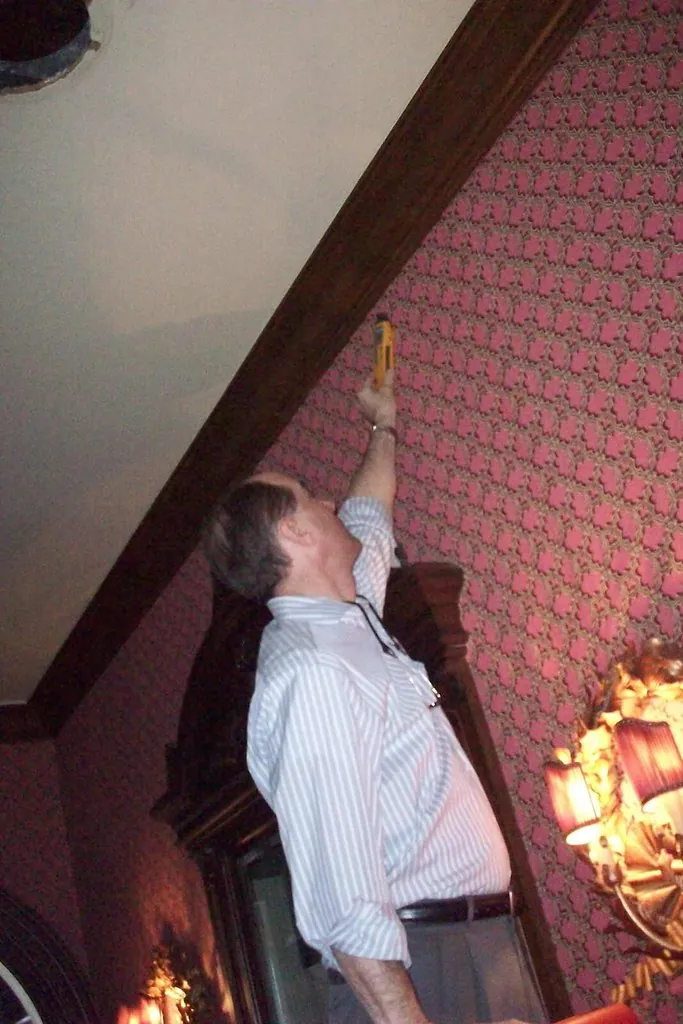
- Checking behind suspect walls. A pinless scan of a wall below a bathroom or behind a kitchen can reveal supply-line seepage months before it would ever show on the surface.
- Verifying drying after a leak. After repairs, meters confirm that materials have actually returned to dry baseline, not just surface-dry. This is critical for preventing mold regrowth.
- Inspecting concrete slabs. Specialized concrete meters and probes measure moisture in and under slabs, a key step in slab leak detection and in diagnosing damp basement floors.
- Pre-purchase and maintenance inspections. A moisture survey of a home's vulnerable areas, under sinks, around toilets, below windows, at the water heater, catches problems while they are still cheap.
- Documenting damage. Dated, quantified readings create an objective record of moisture extent, useful for repair planning and insurance documentation.
A moisture meter does not find leaks by itself. It finds water, and the pattern of that water tells a trained technician where the leak must be. The instrument is only as good as the method behind it.
Reading the Numbers: What Moisture Levels Mean
Moisture readings need context, because every material has a different normal range. Here are the general guidelines professionals use for wood, the most common reference material:
| Wood moisture content | What it means | Action |
|---|---|---|
| 6 to 12 percent | Normal for interior wood in our climate | None needed |
| 13 to 16 percent | Elevated; investigate the cause | Find and address the moisture source |
| 17 to 19 percent | High risk zone for mold growth | Active drying and source repair needed |
| 20 percent and above | Wood decay fungi can take hold; structural risk | Urgent: repair, dry, assess for rot |
For drywall, concrete, and other materials, professionals use relative scales and, more importantly, compare suspect readings against dry reference readings of the same material in the same building. A drywall reading of 35 on a relative scale means nothing alone, but if the reference wall reads 12 and the suspect wall reads 35, you have a problem, and the gradient between them points to the source.
One caution: moisture meters can be fooled. Metal behind a wall, certain paints, and recently applied joint compound can all skew pinless readings. That is why professionals cross-check with a second method rather than trusting any single number.
Moisture Meters and Thermal Cameras: Better Together
The most powerful inspection pairs moisture meters with thermal imaging. The thermal camera scans large areas in seconds, revealing cool patterns that suggest moisture. The moisture meter then verifies those patterns with hard numbers at specific points. Thermal finds the suspects; the meter confirms the evidence. Add acoustic listening for pressurized supply leaks, and you have a diagnostic trio that very few hidden leaks can evade.
Moisture meters turn invisible water problems into visible, measurable facts. If you are dealing with musty odors, unexplained staining, or a suspected intrusion anywhere in your Lynnwood home, call ProLine Leak Fix Pros at (425) 380-0028. We will map the moisture, trace it to its source, and show you exactly what needs to happen next. Serving Lynnwood, Picnic Point, Halls Lake, and surrounding Snohomish County neighborhoods.